
Opelika Directory Collections by Year
Verified Opelika city directory holdings begin with a free 1923 volume published by R. L. Polk & Co. That book combines Opelika, Auburn, and Lafayette. The Opelika volume's internal parts include householders, an alphabetical list of citizens, and classified business pages. Later verified Opelika volumes sit in the Alabama Department of Archives and History collection LPR104. Those Opelika archive boxes contain separate Opelika books through 1982 and combined Opelika-Auburn books from 1984 through 1992. The Opelika years are intermittent, so no missing year should be treated as proof that a person left town.
| Collection | Verified years | Where held | How to reach it |
|---|---|---|---|
| Polk's Opelika City Directory | 1923 | Internet Archive | Free page images online |
| ADAH LPR104, Box 163 | 1960, 1962, 1965, 1967, 1969, 1971, 1972, 1974, 1976 | Alabama Archives | Onsite or archive request |
| ADAH LPR104, Box 164 | 1977, 1982 | Alabama Archives | Onsite or archive request |
| ADAH LPR104, Box 199 | 1984, 1985, 1986, 1989, 1990, 1991, 1992 | Alabama Archives | Onsite or archive request |
| OPL genealogy collection | Exact run not published | Opelika Public Library | Non-circulating; call for shelf check |
The Internet Archive scan of the 1923 directory shows how the earliest verified Opelika book is arranged.
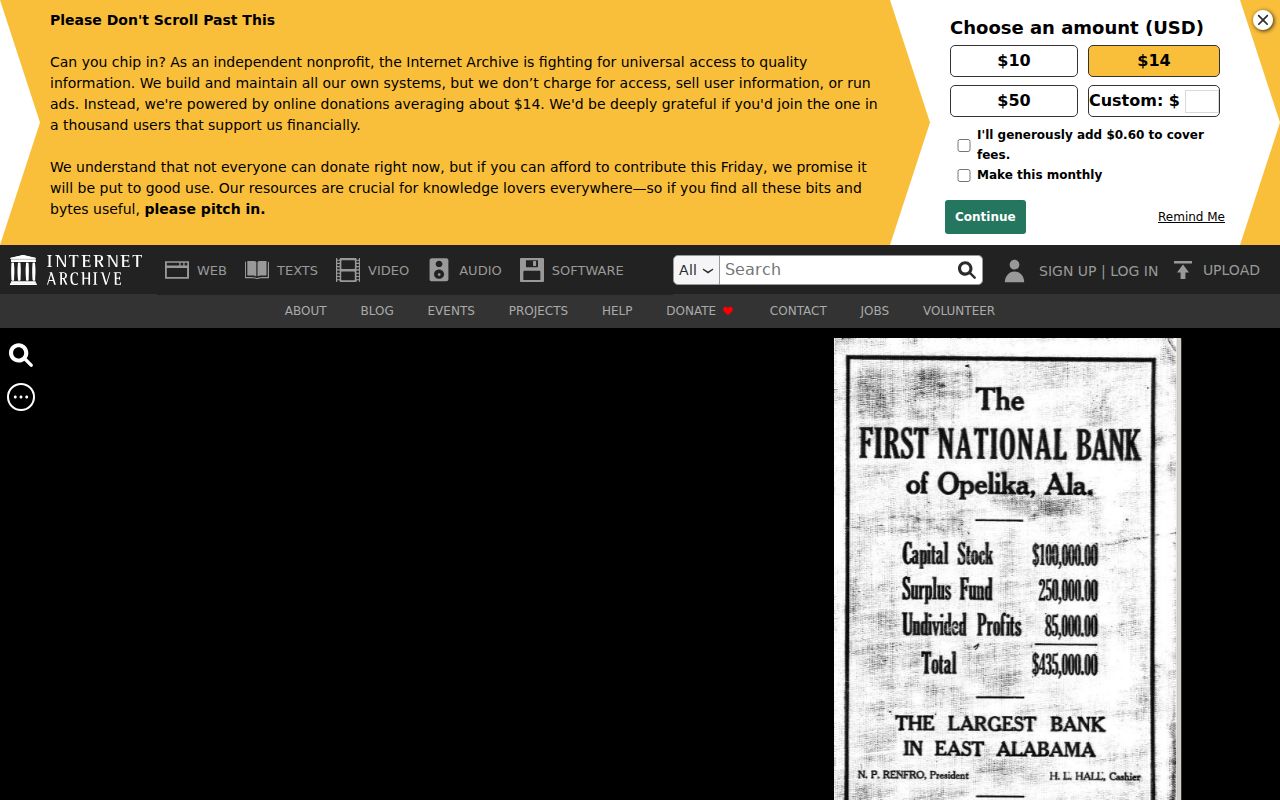
The Opelika scan is a full-volume source, not a loose name index. Page context, Opelika headings, and the printed key should be saved with every cited Opelika entry.
Four Opelika Directory Search Paths
The 1923 Opelika city directory works in more than one direction. The alphabetical Opelika citizens section starts with a surname. The Street and Avenue Guide begins with a place and leads to a householder. A buyer's guide links Opelika firms to places, while classified pages group trades and services. This four-part structure can separate people who share a surname, connect a worker to a business entry, or test whether an Opelika street address and an Opelika person appear together.
The Opelika householder pages run from 53 through 68, citizens from 69 through 149, and business listings from 207 through 244. Because the Opelika binding includes three cities, first confirm that the page and heading belong to Opelika. An Opelika name hit should be copied with the full printed line and Opelika scan page reference. Then inspect the same Opelika address in the street section and read the nearby Opelika numbers and intersections. OCR is useful for discovery, but the image is the record.
The 1923 resident-page view makes the Opelika column layout and compact printed lines clear.
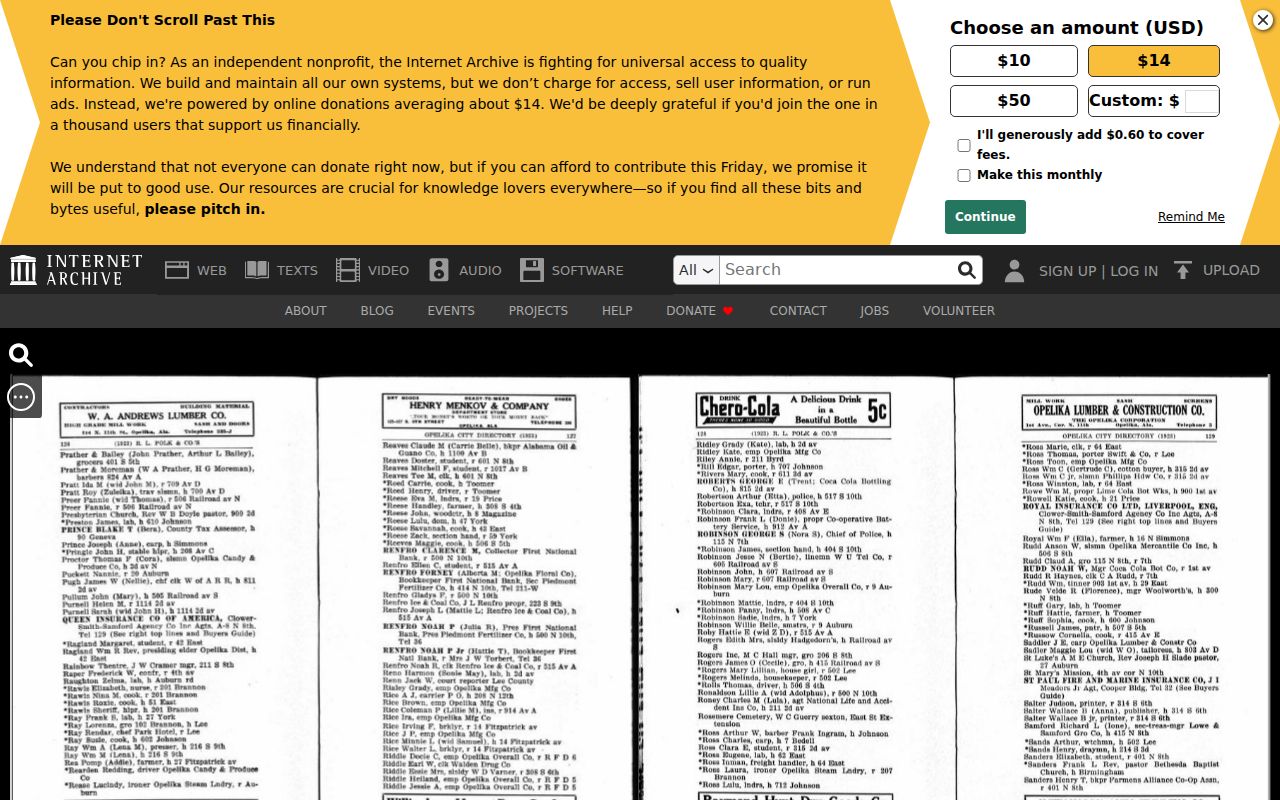
The Opelika page image also shows why initials, abbreviations, and neighboring entries must be read in context rather than copied from one Opelika search result.
Note: A person-first hit and an address-first hit are independent checks inside the same Opelika directory, but another Opelika source is still needed.
Reading an Opelika City Directory Entry
An Opelika directory line can compress several facts into a few words. The 1923 Opelika inspection supports surname and given name or initials, spouse in parentheses, trade or employer, business address, residence or boarding notation, street number, and widow status. One documented line connects a druggist named Lindsey with 207 Avenue A. That example shows the kind of link the Opelika book can provide, but the exact Opelika abbreviation key should be checked before expanding a symbol or letter.
| Printed name | Surname, given name, initials, and sometimes a spouse notation |
|---|---|
| Work clue | Occupation, business, employer, or a separate business address |
| Place clue | Residence, room, boarding notation, house number, and street |
| Family clue | Spouse in parentheses or widow notation |
| Page context | City heading, nearby entries, section, and printed abbreviation key |
Do not add an owner or renter label unless the Opelika volume's own key supports it. An Opelika directory usually identifies a householder or listed resident, not every person under the roof. Spelling can shift between Opelika lists, and initials can hide an Opelika same-name conflict. Preserve the line as printed before normalizing it.
- Criss-cross directory
- An address-first list that reverses the usual name search and groups householders by Opelika street.
- Householder index
- A street-order section that ties a numbered address to the listed Opelika person at that date.
- Abbreviation key
- The Opelika publisher's legend for short forms used for work, residence, boarding, and family status.
- Directory snapshot
- A dated listing that proves an Opelika appearance in one edition, not continuous presence between editions.
Bridging Opelika City Directory Gaps
The Alabama Archives finding aid is the authority for the physical Opelika year list. It does not confirm the publisher, completeness, physical condition, or presence of a reverse section in each later Opelika book. An Opelika archive request should name LPR104, the box, and the desired year. Ask staff to inspect the title page, contents, abbreviation key, and any address-first section. That keeps the answer tied to the Opelika volume rather than an assumption based on the collection label.
The ADAH Opelika directory finding aid documents the exact 1960 through 1992 holdings and their box locations. A volume request can be made onsite or through archive research services. The research service costs $15 for an Alabama resident or $25 for an out-of-state requester, includes up to 20 pages, limits a request to one surname and four sources, and ordinarily takes two to three weeks. Extra pages are $0.25 each.
The archive run has meaningful gaps: 1961, 1963, 1964, 1966, 1968, 1970, 1973, 1975, 1978 through 1981, 1983, 1987, and 1988 are not on the verified list. Those absences describe the shelf, not the resident. Fill them with deeds, census records, obituaries, church sources, and dated news instead of inventing annual continuity.
Opelika Library Directory Research
The Opelika Public Library Genealogy Room is non-circulating and sits past the Study Rooms. Its catalog confirms city-directory material but does not publish a full year run. A careful shelf check should ask separately for directory books, telephone books, reverse or criss-cross books, obituary indexes, and school yearbooks. Formats can be cataloged under different terms. General library hours are Monday through Thursday, 8:30 a.m. to 7 p.m., and Friday through Saturday, 8:30 a.m. to 5:30 p.m. The library is at 1100 Glenn Street, and its main number is 334-705-5380.
Archives help is available Tuesday through Thursday from 9 a.m. to noon and 1 to 6 p.m., and Friday from 8:30 to 11 a.m. and noon to 5 p.m. Monday and Saturday visits require an appointment. Access also varies by database. Ancestry Library Edition works only on library computers. HeritageQuest is remote with a library card. HeritageHub supplies obituary and death-notice images, while Community History Archives offers free newspapers, photographs, and documents.
The OPL genealogy research page displays these schedules and access differences.
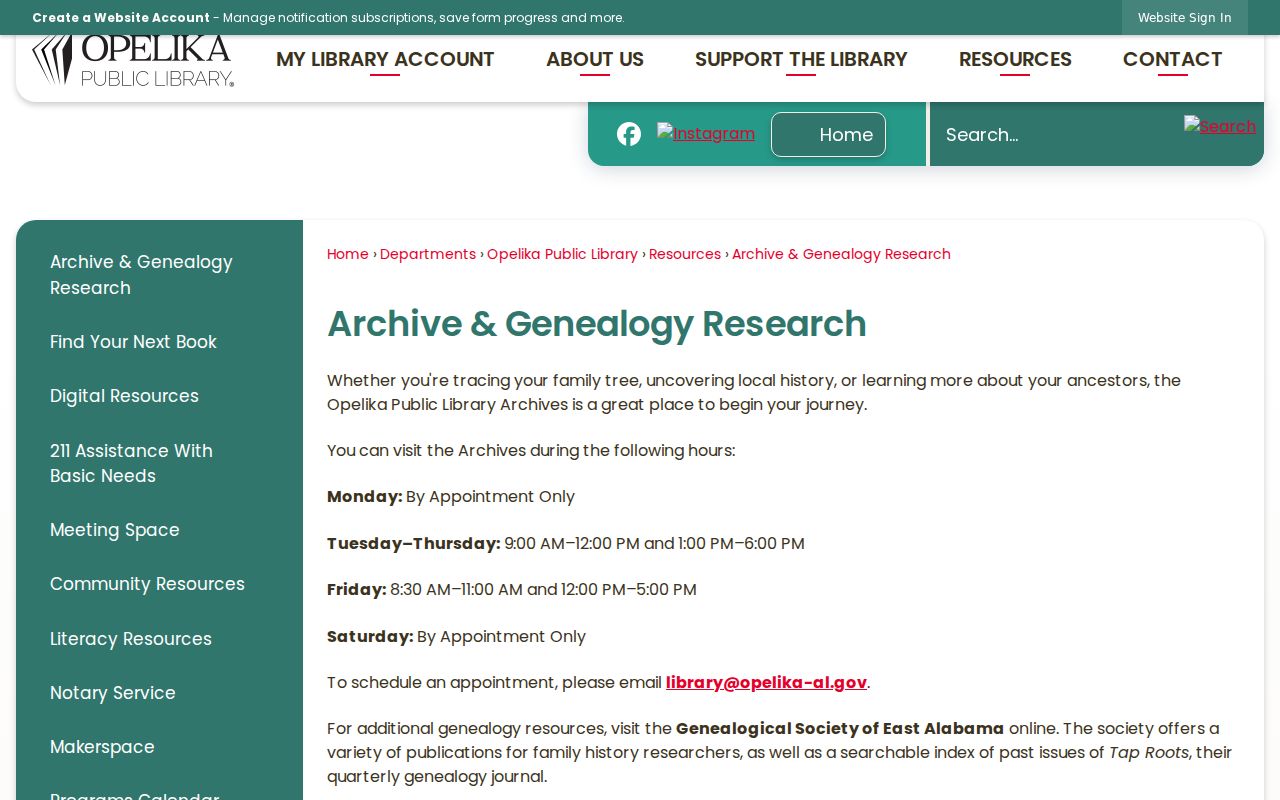
The captured library page is the practical fallback when a volume, obituary image, or yearbook is not freely searchable from home.
Trace Families in Opelika Directories
A family chronology works best when every row states what role the source proves. A dated volume may identify a listed resident or householder. A census may show household members and relationships. A deed names parties and land, while an obituary may supply kin. Mixing those roles turns a clue into a claim the records do not support.
- Search the 1923 alphabetical list for the full name, initials, spouse, work, and residence. Save the page reference.
- Reverse the address in the Street and Avenue Guide. Record nearby numbers and intersections, but do not assume each nearby house held relatives.
- Pair the entry with the 1920 and 1930 censuses. In 2026, the 1950 census is the latest public population census under the 72-year rule.
- Move to the exact ADAH years. Create a separate row for each edition and mark unrepresented years as gaps.
- Close the trail with deeds, probate, an obituary, a church roll, a verified yearbook, or the city cemetery map.
A person appearing in both 1923 and 1960 is not shown continuously in Opelika for the 37 years between those sources. A sound timeline keeps dates, spelling, address as printed, source, role, and confidence separate. For a modern address-keyed approach, the Opelika street directory explains the county property and parcel route without rebuilding the historical shelf.
Map Opelika Directory Addresses
University of Alabama holdings list Opelika Sanborn fire-insurance maps for January 1885, June 1888, December 1893, May 1898, February and July 1903, and 1909. Coverage grew from three sheets in 1885 to thirteen in 1909. The sheets predate the 1923 directory, yet they can show whether a block was built, whether a street name or number changed, and how a structure's footprint, material, use, and outbuildings evolved.
The maps do not name occupants. Use the Opelika Sanborn map inventory for structural context, then rely on a directory, deed, or census for a person's link to the place. This distinction matters in downtown, where an 1868 fire led to commercial rebuilding, and in Northside, Geneva, and Pepperell, where building dates and street form span distinct eras. The fire is not documented as a loss of courthouse records.
| 1885 | Three sheets, the earliest verified Opelika edition |
|---|---|
| 1888 | Three sheets |
| 1893 and 1898 | Four sheets in each edition |
| February 1903 | Five sheets |
| July 1903 | Seven sheets |
| 1909 | Thirteen sheets, the broadest verified edition |
Beyond the Opelika Directory Shelf
Auburn University Special Collections holds Opelika material that can distinguish families whom civil indexes merge. Its subject holdings include the Denson Family Papers, Robert A. Betts Lee County research, a T. L. Dickson Hardware ledger with individual accounts from 1912 through 1965, First Baptist records with membership rolls and directories from 1899 through 2015, Kiwanis material, and Opelika Observer records. Camp Opelika papers cover 1943 through 1969. Finding aids also identify church materials, though access limits should be verified before a visit.
The Auburn Opelika subject guide is the entry point for those named collections.
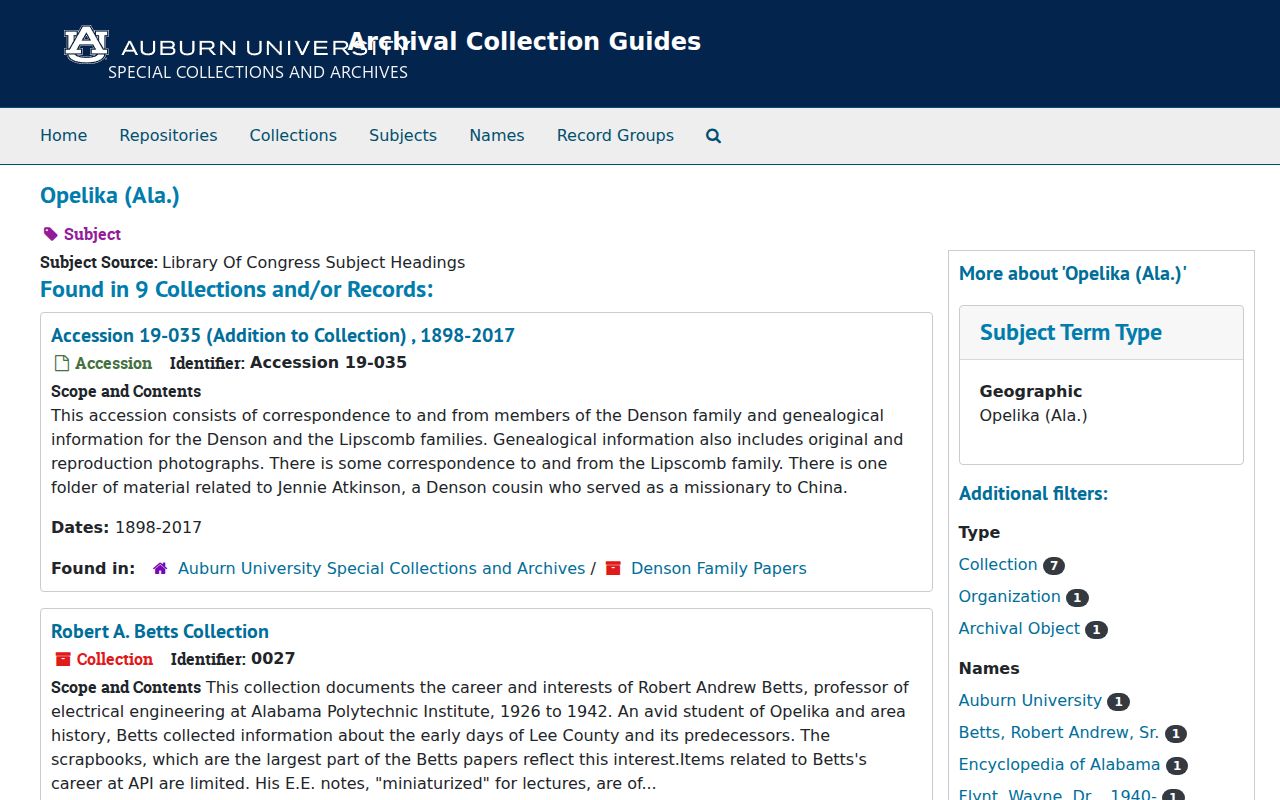
The finding aid broadens a directory search with church membership, customer accounts, family papers, clubs, and local press while keeping each source's role clear.
Secondary cataloging also lists Opelika High yearbooks for selected years from 1927 through 2007. Licensed access and the actual volume should be confirmed. A yearbook proves school context at a date; it does not prove a later address. First Baptist membership rolls prove a congregation record, and the hardware ledger proves an account. Neither should be relabeled as a complete Opelika residents list.
Opelika Directory Timeline
Local jurisdiction matters before any historical directory search. Lee County was formed on December 5, 1866 from parts of Macon, Russell, Chambers, and Tallapoosa Counties, and Opelika became the county seat. A person or parcel before that date may be indexed under a parent county, especially Russell. Horace King built the first Lee County courthouse in 1867; the present courthouse was erected across the street in 1896.
- 1866: Lee County is created, changing the likely county index for older Opelika people and land.
- 1885 to 1909: Seven verified Sanborn editions chart structures and streets before the first verified directory.
- 1923: R. L. Polk publishes the free, dual-access Opelika, Auburn, and Lafayette volume.
- 1960 to 1982: Intermittent Opelika directory years appear in ADAH LPR104.
- 1984 to 1992: Verified archive holdings shift to combined Opelika-Auburn volumes.
No source confirms Opelika's first or last printed directory year. That limit should remain explicit. The verified books provide strong dated evidence, but the best family account combines them with maps, public census years, probate, church sources, newspapers, and the exact record office that holds each document.