
Find Opelika Residents by Clue
An Opelika residents directory search works best when the first step matches the clue already in hand. An Opelika street address belongs in the Lee County property search. A current Opelika name can be tested against the owner roll, court parties, a business filing, or a license record. An Opelika name from decades ago belongs in a dated directory, census, obituary, or probate file. Each source has a narrow role. The Opelika property roll identifies an assessed owner, not every person at the address. VoterView checks one known voter. A deed links named parties to land. A city directory captures a household at one dated snapshot.
Keep a small source log as the Opelika search grows. Record the exact spelling, initials, date, address, role, and source link. Opelika and Auburn names can overlap in regional collections, so Opelika context and date matter. Two independent identifiers are far safer than one surname. A spouse, middle initial, parcel number, business role, or old Opelika street address can separate people who share a name.
- Start with the known name or address in the Lee County owner roll, and save every plausible parcel number.
- Compare physical and owner-mailing addresses without assuming either one proves where a person lives.
- Use the deed book, page, and date to continue at the Lee County Judge of Probate records counter.
- Check a known registrant through Alabama VoterView, or move an older name into dated directory and census sources.
- When no portal covers the record, contact the correct clerk, library, archive, or records officer with a narrow request.
That sequence creates an evidence trail instead of a loose list of similar names. It also keeps the Opelika directory search focused on public, lawful personal research.
Opelika Resident Records Desks
Opelika is both a city and the Lee County seat, so several key Opelika resident records are kept within the city. The Opelika offices do not share one index. Revenue manages Opelika assessment and parcel data. Probate holds land instruments, estates, wills, plats, and marriage records. The Circuit Clerk handles Lee County trial-court files. Opelika city records such as permits and municipal requests remain with Opelika offices. For Opelika research, calling the right custodian first avoids a request being sent between governments.
Lee County Judge of Probate
215 S. 9th St.
Opelika, AL 36801
334-737-3670
Lee County Revenue Commissioner
Lee County Courthouse
Opelika, AL 36801
334-737-3655
In Opelika, Probate and Revenue are distinct even though both help with land research. Revenue supplies the current Opelika parcel lead. Probate supplies the recorded instrument. Circuit and district case questions go to the Circuit Clerk, while Opelika ordinance and traffic matters go to Opelika Municipal Court. The full address workflow belongs in the Opelika street directory.
Opelika Property Roll First
The free Lee CAMA search is the broadest current directory-like source for Opelika property. It accepts an Opelika owner name, physical street number, street name, parcel, PPIN, acreage range, value range, tax district, or subdivision. An Opelika owner search can use “begins with” when spelling is firm or “contains” when a name may vary. District can narrow a countywide result set to Opelika. Opelika results may be printed, mapped, or exported, but broad searches stop at 1,000 rows.
| Opelika search field | Input | Best use | Key limit |
|---|---|---|---|
| Owner | Text plus match mode | Known surname or owner | Trusts and firms may appear |
| PhyAddr # | Up to five characters | One street number | Use with street name |
| St Name | Contains text | One road or block | Format can affect matches |
| District | Dropdown | Separate Opelika from other areas | Postal city is different |
| Subdivsn | Dropdown | Platted area search | Not a household list |
An Opelika parcel card can show the assessed owner, separate situs and owner-mailing addresses, PPIN, acreage, value, exemptions, subdivision, and deed or plat references. “Situs” means the taxed physical location. An Opelika parcel is a mapped unit of land with its own identifier. Neither Opelika address field proves every occupant. The assessment cycle can also lag a midyear deed because Alabama property tax follows title on the prior October 1.
Note: Matching physical and mailing addresses plus a homestead clue can support owner occupancy, but none creates a complete Opelika household roll.
Opelika Deed Trail Goes Offline
The current Opelika parcel card is a bridge to the Lee County Records Vault. It often supplies the Opelika deed book, page, date, legal description, and plat reference needed for a precise request. Lee County has no verified public web deed index. Public terminals at Probate carry an electronic index from July 1, 1986, while electronic images begin June 1, 1997. Earlier Opelika work returns to handwritten grantor and grantee cards and bound books. A grantor transfers an interest; a grantee receives it.
This is one of Opelika’s most useful inside moves: take book, page, and recording date from CAMA before asking for a mailed copy. Staff can assist an in-person Opelika visitor who knows only a name, but a narrow citation is more efficient by mail. Older Opelika computer history should be checked against the handwritten index. The reported 1:00 to 2:30 p.m. period can be busy, so a call before a long Opelika records visit is sensible.
Practical bridge: Save the parcel key and deed citation online, then use the Probate terminal or mail channel for the actual title record.
Current Opelika Directory Sources
No current Opelika residents directory covers all people. Instead, official Opelika rolls identify specific roles. Opelika property data names assessed owners. VoterView confirms facts for one known Opelika registrant. Court indexes identify parties within the limits of public access. Opelika city systems list staff or permit participants. Probate records preserve parties to deeds and estates. Opelika community groups publish contacts, but the research found no verified public neighborhood membership roster.
| Resident source | What the Opelika record identifies | Keeper | Access route |
|---|---|---|---|
| Property roll | Assessed owner and parcel facts | Lee Revenue | Free CAMA and GIS |
| Voter record | Known registrant status and polling place | Alabama election system | Self-check or ordered extract |
| Recorded instruments | Deed, lien, plat, and estate parties | Lee Probate | Terminal, counter, or mail |
| Permit records | Applicants, project address, and inspections | Opelika Building Inspection | Portal or records request |
| Cemetery map | Interment and grave location | Opelika Cemetery Division | Official map and office help |
Choose the Opelika row by the fact to prove. An Opelika parcel owner is not automatically an occupant. An Opelika permit participant is tied to a project, not a complete resident roll. An Opelika court party is connected to one case. For a focused name-in, records-out method, use the Opelika resident lookup.
Opelika Voter Data Has Limits
Alabama VoterView is a self-check, not a browseable Opelika directory. For an Opelika check, it requires first name, last name, date of birth, and a CAPTCHA. An Opelika match can confirm registration, ballot status, and polling location. It cannot list an Opelika block, street, or ZIP code. That distinction prevents a search meant for one known Opelika voter from being treated as a neighborhood roll.
A separate Opelika voter-list request under Ala. Code §17-4-38 can select public fields such as name, status, residence address, mailing address, available phone, registration date, and participation history. Participation never shows a ballot choice, and Alabama does not register voters by party. The Opelika requester chooses scope and format, receives a quote, and then pays. That ordered Opelika channel is different from the free VoterView form.
Use Opelika voter data only for a lawful, focused purpose. A missing Opelika VoterView match can reflect input, status, protection, or a different jurisdiction. It does not establish that a person is absent from Opelika.
Three Opelika Court Record Paths
“Opelika court record” can point to three separate systems. Opelika Municipal Court handles city ordinance and traffic matters. The Lee County Circuit Clerk at the T.K. Davis Justice Center keeps circuit and district civil and criminal files, along with domestic-relations and juvenile matters subject to access rules. Federal cases for the Eastern Division of Alabama’s Middle District use PACER; the Opelika federal courthouse is unstaffed for filings.
For an Opelika case, state trial-court remote access through Just One Look is account and purchase gated. The public landing page reveals only limited selected-case information. Free inspection at the Lee Clerk remains an Opelika alternative, and a mail or counter form can request copies. The form asks for identifiers such as a case number, party, charge, and date of birth because a name alone is risky.
The Alabama trial-court access screen shows why a portal is not always the end of the search.
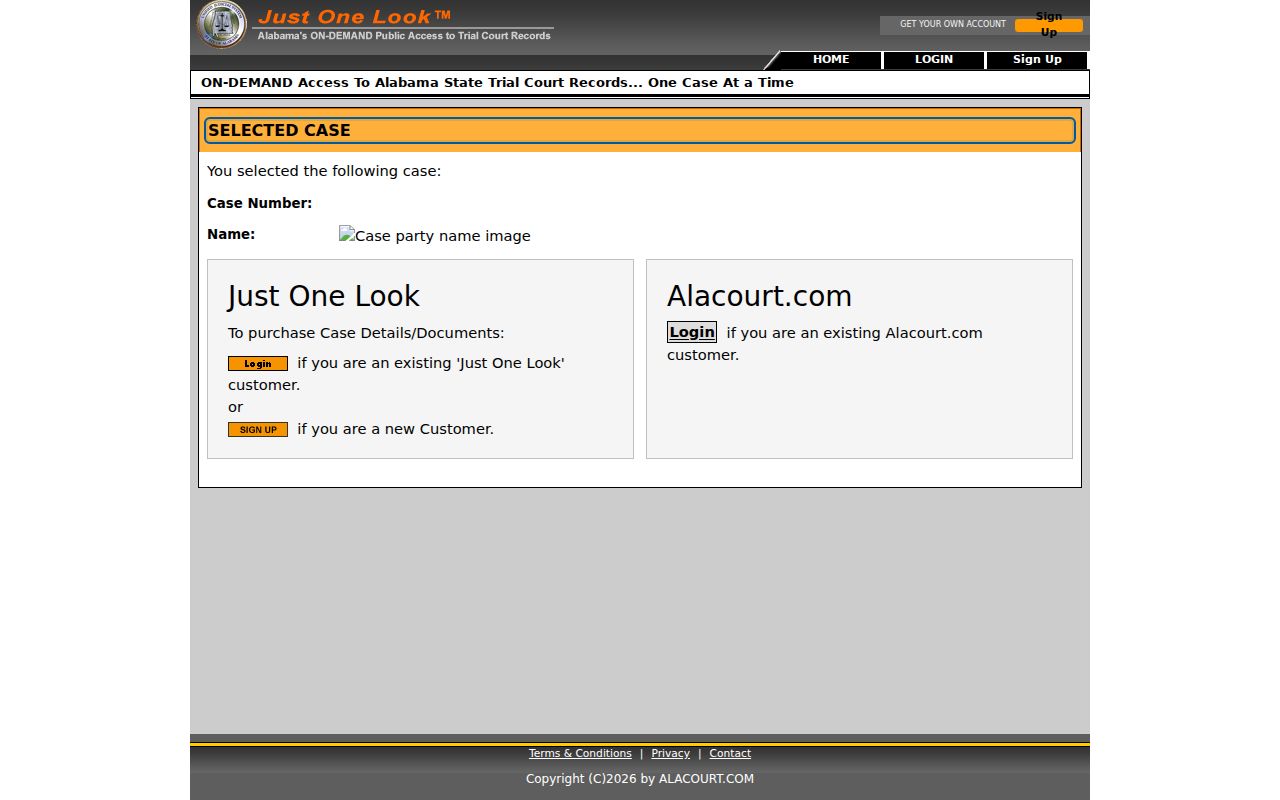
Its login and purchase gate mean a complete Opelika case check may shift to the Lee County counter or copy-request form rather than stop online.
Historical Opelika Resident Shelves
Historical Opelika resident directories begin with a verified, freely scanned 1923 R. L. Polk volume covering Opelika, Auburn, and Lafayette. The Opelika book works in both directions. Alphabetical pages lead from a person to an address, while the street and avenue guide leads from an address to a householder. The combined geography is useful for mobile families, but city headings must be watched so similar names are not merged.
Alabama Archives lists intermittent Opelika volumes for 1960, 1962, 1965, 1967, 1969, 1971, 1972, 1974, 1976, 1977, and 1982. Combined Opelika-Auburn volumes are listed for 1984, 1985, 1986, 1989, 1990, 1991, and 1992. These are snapshots, not proof of continuous presence between years. The Opelika Public Library Genealogy Room confirms local directory material, though its exact year run is not published.
- City directory
- A dated book that may list a person, address, spouse, and occupation.
- Criss-cross directory
- An address-first arrangement that reverses the usual name search.
- Index
- A finding tool that points to a record; it is not always the full record image.
- Roll
- An official list created for one government purpose, such as assessment or registration.
OPL adds onsite Ancestry Library Edition, remote HeritageQuest with a card, HeritageHub obituary images, and free Community History Archives material. The detailed shelf and reading method are covered in the Opelika directory-book section of the site navigation.
Opelika Cemetery Names Reconnect Families
Opelika’s Cemetery Division maintains records and map access for Rosemere, Evergreen, and Garden Hills. A map search can locate a loved one, identify the grave, and produce a printable map. Rosemere was added to the Alabama Historic Cemetery Registry in 2011. This municipal name source is valuable when an obituary ends with burial information or a directory trail stops after a death.
The strongest Opelika family-history result pairs the cemetery entry with other evidence. Record the cemetery, section, lot, grave, interment name, and date. Then compare the obituary, an eligible or open death certificate, probate material, church records, and old newspapers. A marker can differ from civil registration. Preserve both readings and label each source by what it proves.
Can a grave record prove residence? No. It proves an interment and location. It can, however, bridge a familiar Opelika name to an obituary or estate file that carries stronger family and address detail.
Opelika Permits Add Address Dates
The Opelika Business Portal searches registered projects, permits, inspections, plans, and invoice status without requiring registration for public searching. Inspection mode has an Advanced address and date route. Results can be sorted, inspection numbers open details, and the checklist control opens comments. A file may contain an application, plan review, utility approvals, inspection tickets, tags, final inspection, and a certificate of occupancy.
Opelika permit evidence belongs on a timeline, not in a household list. It can date work, identify an applicant or contractor, and show whether an inspection passed. It does not identify every person at an address. The online starting year was not verified. If the search is blank, call Building Inspection at 334-705-5420 or ask through the City Clerk’s records process for a defined address, record class, and date span.
Note: For a full Opelika permit history, request the application, review, trade permits, inspection comments, and completion record as separate parts of one address file.
Opelika Requests Changed in 2024
Opelika adopted a written public-records policy in September 2024. The City Clerk is the Public Records Officer. An Alabama resident may submit a city request by hand, mail, email, or the Opelika NextRequest portal, and proof of state residence may be required. Onsite inspection can be free. Standard paper pages are listed at $0.50, while ordinary electronic delivery has no per-page fee, though departmental, large-format, search, and redaction costs can apply.
The portal is a municipal fallback, not a universal records desk. City permits, licenses, cemetery matters, and city administration fit there. Lee County deeds belong with Probate, county cases with the Circuit Clerk, and state vital certificates with the Alabama Department of Public Health. A focused request names the person or address, record class, and date range.
The current Opelika request system provides a clear online handoff when a city record is not already published.
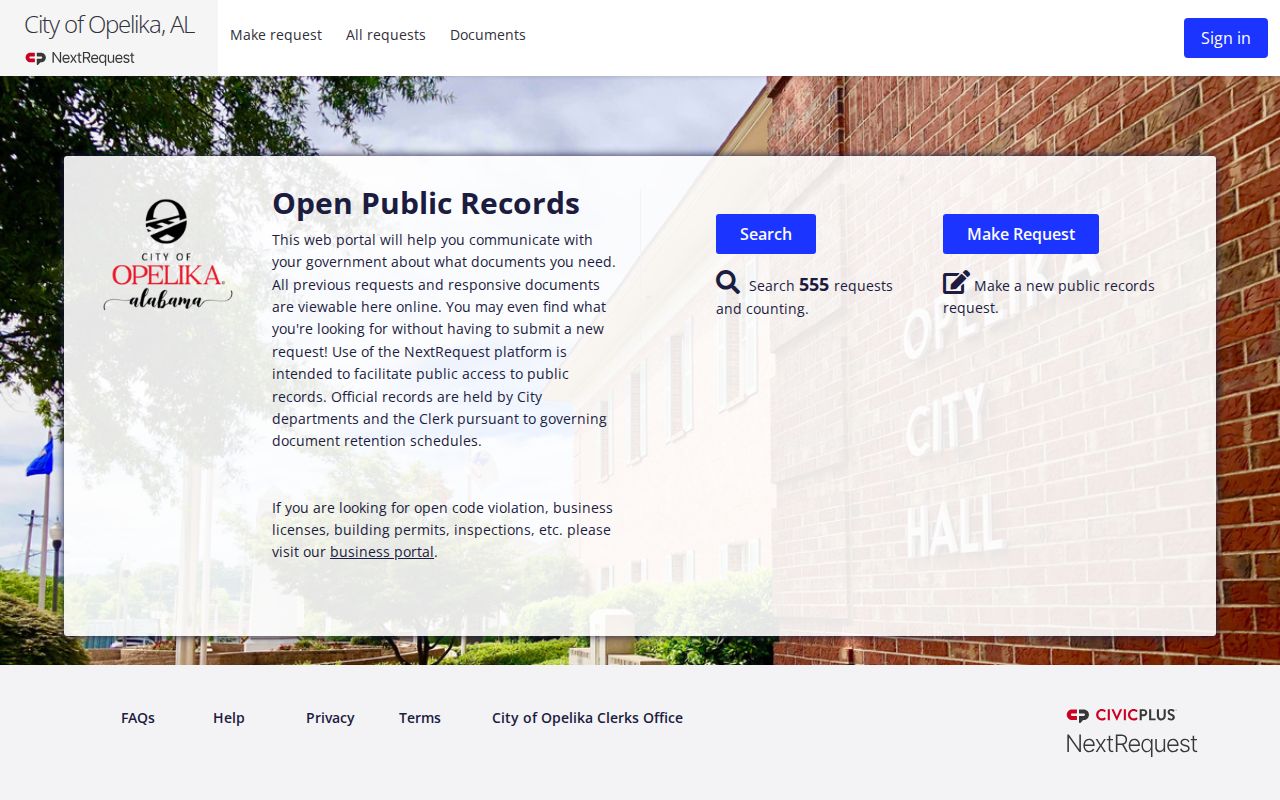
The request form supports the documented city workflow while keeping county, court, and state custodians separate.
Opelika Records Before Lee County
Lee County was created on December 5, 1866 from parts of Macon, Russell, Chambers, and Tallapoosa Counties. Opelika became the county seat. A person, family, or parcel that predates the county may therefore appear under a parent county, especially Russell, rather than in an early Lee index. This boundary change explains a gap more often than a claim that no record exists.
Horace King built the first Lee County courthouse in 1867. The current courthouse rose across the street in 1896. An accidental 1868 fire destroyed much of Opelika’s business district, but the researched history does not say courthouse records burned. Treating that commercial fire as a courthouse-loss event would turn local color into a false records claim.
For an early Opelika search, preserve the land description and test the relevant parent-county index. Distinguish a missing year, a jurisdiction change, and a documented loss. They are three different findings.
Compare Opelika Resident Search Channels
Official channels differ in cost, depth, and proof. Lee CAMA and GIS are free and rich in current parcel detail. Probate’s deed trail is stronger for title but moves to terminals, books, and copy requests. State court access is remotely gated, while clerk inspection provides another route. Historical directories can be free online or available by archive request. Commercial people-finder products compile mixed public and commercial data, but stale addresses and merged identities require official checks.
| Channel | Opelika strength | Access | What still needs proof |
|---|---|---|---|
| CAMA and GIS | Current parcel and owner lead | Free online | Occupancy and current deed |
| Probate records | Recorded title and estate trail | Terminal, books, mail | Identity across similar names |
| Court records | Case party and filed action | Portal, counter, form | Protected or sealed content |
| Library and archives | Dated resident snapshots | Online, onsite, request | Years between volumes |
| Commercial category | Broad lead gathering | Often paid | Every identity and address fact |
A good Opelika residents directory result cites the original roll or custodian. A convenient compilation can suggest where to look, but it should not replace a deed, parcel card, court file, voter confirmation, or dated directory image.
Opelika Resident Privacy Boundaries
Public access is record-specific in Alabama. Birth certificates remain restricted for 125 years and death certificates for 25 years under Ala. Code §22-9A-21. Recent copies have eligibility and identification rules. Court rules close sealed matters and protect specified juvenile, adoption, victim, shelter, at-risk-party, and child-location information. Driver data has separate federal limits. No official statewide general substitute-address program was located, so protections must be checked record by record.
A public record is not permission to threaten, stalk, harass, or expose a protected person. Alabama harassment and stalking laws still apply to conduct built from public-source research. Limit any Opelika resident lookup to facts needed for a lawful personal purpose. Do not publish a block roster, infer unnamed people from a parcel owner, or treat a missing portal result as proof about a person.
Lawful use only: Verify each Opelika record with its custodian, respect sealed and confidential fields, and never use directory data to stalk, harass, or harm anyone.
When information is wrong, the office that holds the source record controls correction. Commercial directory removals are service by service, and records may later repopulate. Keep confirmation of any opt-out and return to the official source when accuracy matters.