
Opelika Resident Source Map
An Opelika resident lookup works best as a set of narrow questions. The free Lee County assessment roll can connect an Opelika owner to a parcel, but it does not identify all occupants. Alabama VoterView can confirm one Opelika registrant's own status and polling place, while a separately ordered voter extract may contain selected public fields. Opelika court, vital, probate, business, and professional records each document a different event or role. The source chosen for Opelika should match the fact being tested.
| Record | Fact It Can Confirm | Official Keeper | Access Route |
|---|---|---|---|
| Opelika property | Assessed owner, situs, mailing address, deed lead | Lee County Revenue Commissioner | Free CAMA search |
| Opelika voter | Personal registration status and polling place | Alabama Secretary of State | Self-check or ordered extract |
| Opelika court | Party name, case number, case type, disposition | Municipal, Lee County, or federal clerk | Counter, form, or paid portal |
| Opelika vital | Registered birth, death, marriage, or divorce event | Alabama Department of Public Health | County counter, mail, or authorized vendor |
| Opelika probate | Estate, heir, deed, will, or marriage evidence | Lee County Judge of Probate | Terminal, counter, or mail |
| Opelika business or license | Public officer, agent, credential, status, or filing | Secretary of State or state board | Free official lookup |
Start with the strongest Opelika key. A known Opelika address points to CAMA and the parcel map. A current Opelika name can be tested in property, court, business, and license sources. A historical Opelika name may need directories, an obituary, probate, or cemetery records. A resident lookup becomes much stronger when two independent Opelika identifiers agree, such as a middle initial and spouse, or a parcel description and deed date.
Looking Up Opelika Court Records
Opelika jurisdiction comes first. Opelika Municipal Court handles city ordinance and traffic matters by phone or counter. The Lee County Circuit Clerk keeps Opelika circuit and district civil and criminal files, plus domestic-relations records, at the T.K. Davis Justice Center. Opelika probate matters belong to the Judge of Probate. Federal party and docket searches use PACER, and the Opelika federal courthouse is unstaffed for filings. The active federal clerk is in Montgomery.
Alabama's Just One Look service is account and purchase gated. Its public landing screen reveals a selected Opelika case number and name, but the research did not establish complete fields, remote coverage dates, or document prices. Free courthouse inspection remains an important Opelika fallback. The Lee Clerk also accepts a mail or counter copy and archive-search form. It asks for an Opelika case number when known, party name, charge, date of birth, requested document, and certification choice. Allow at least seven working days.
An Opelika result may contain several distinct facts:
- the Opelika case number and court division;
- the Opelika party name and role in the case;
- the Opelika case type, filing activity, and signed orders;
- a judgment, disposition, or case-action summary; and
- copy or certification status from the clerk.
Note: Sealed cases and specified juvenile, adoption, victim, shelter, child-location, and at-risk-party information do not appear through ordinary Opelika public access.
Confirming an Opelika Resident
Opelika name matches are leads, not conclusions. Opelika has grown, and broad county searches can return many people in Opelika who share a surname. Preserve the full name used in Opelika, including initials, suffix, former name, and married name, before comparing records. An Opelika parcel owned by a trust, estate, or business may hide the person's name. An Opelika court party with the same surname may have no tie to the parcel. Cross-check only facts the records truly disclose.
- Search the Lee County CAMA owner field with “begins with” when the Opelika name's spelling is firm, or “contains” for a careful variant search. Save each plausible PPIN and the separate situs and mailing fields.
- Compare a second Opelika identifier. Useful checks include a co-owner, middle initial, subdivision, deed book and page, public business role, filing date, or professional credential.
- Choose the right Opelika court. Match the case number, party role, type, and date instead of relying on a name alone. Inspect at the clerk if the paid screen is too thin.
- Request an Opelika certified copy from the custodian only when formal proof is needed. An index entry points to a record, but it is not the record image or certified copy.
- Docket
- The Opelika court's dated list of filings, hearings, orders, and other case activity.
- Index
- A finding aid for Opelika that points to a file or instrument. It may show less than the full image.
- Certified copy
- A copy issued by an Opelika custodian with formal confirmation that it matches the official record.
A resident lookup should keep uncertainty visible. If only the surname and city match, label the result unresolved. If an Opelika parcel, deed recital, and independent filing share a fuller identifier, the connection is more sound. Neither pattern proves every current household member.
Opelika Vital Record Checks
The Alabama Center for Health Statistics issues statewide birth, death, marriage, and divorce certificates. Any Alabama county health department can generally issue an eligible Opelika certificate while the requester waits, while mail processing is commonly about seven to ten days. There is no verified open statewide name index for modern Opelika vital events. A recent Opelika birth or death therefore cannot be browsed like a parcel roll.
Alabama closes birth certificates for 125 years and death certificates for 25 years under Ala. Code §22-9A-21. Recent copies are limited to the named person, close family, a legal representative, or another applicant with a documented legal right. The application calls for event details, the requester's relationship and purpose, identification, signature, mailing address, and copy count. A marriage or divorce certificate follows the state certificate channel, but a full divorce decree belongs with the Lee Circuit Clerk.
This long birth closure and shorter death closure are easy to confuse. Historical Opelika work before statewide filing began in 1908 often shifts to county marriage records, cemetery files, church sources, newspapers, census records, and probate. Those sources document different facts and should not be presented as substitute certificates.
Finding Opelika Heirs and Family
Opelika heir research has a direct Opelika trail. Begin with a Lee County probate petition, will, notice, or estate file, then test any named successor against a recorded post-estate deed. The Alabama Treasury unclaimed-property search may supply a free name and location lead, but payment requires proof and a match does not establish present residence. Obituary relationships are useful clues. Court or probate papers may carry the legally stated heir relationship.
For a deceased Opelika resident, the municipal cemetery map can bridge an obituary to an official interment in Rosemere, Evergreen, or Garden Hills. The Opelika Public Library's HeritageHub access adds obituary and death-notice images, while Community History Archives supplies newspapers and photographs. This human-use route helps relatives reconnect with a documented place and date without treating a memorial or news item as current-address proof.
Adult adoptees and birth-family searches follow a separate state process. Alabama adoption files and identifying information are not public resident records. A DHR-placed adoptee may make a written request using the birth name if known, date of birth, and adoptive-parent information. Non-identifying social or medical history, original-birth-certificate information, consent, and court-order routes have different rules. Ordinary name searches do not bypass them.
Note: A probate lead, obituary relationship, cemetery result, and Treasury match each serve a distinct role; agreement matters more than volume.
Checking Opelika Professional Ties
A public license can confirm a credential or regulated role associated with an Opelika name. It does not prove a home address. The official Alabama medical license verification can show a number, license type, status, permitted location, issue and expiration dates, school, certain registrations, collaborations, and public discipline. It withholds full address, birth date, complaints, malpractice, and investigations. The medical board's official search screen illustrates the narrow fields used to distinguish a professional identity:
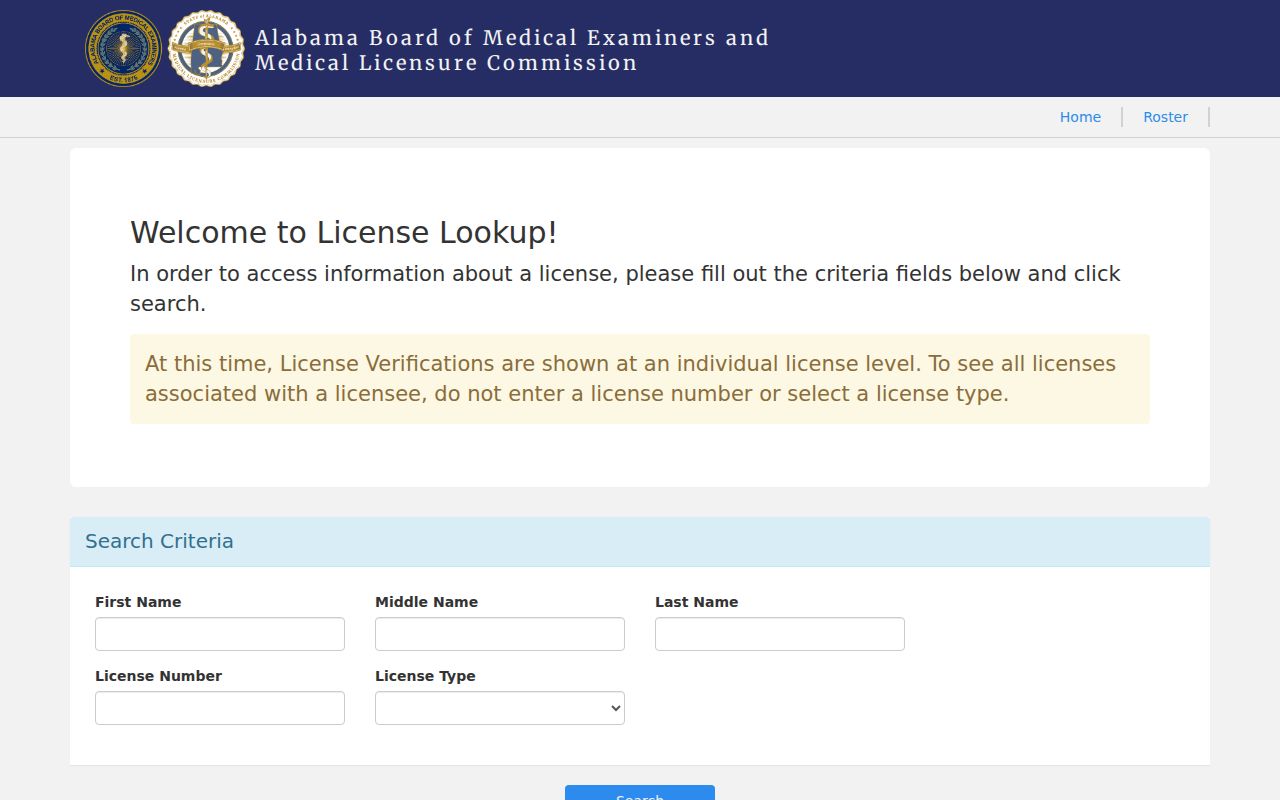
Its status and license number can corroborate a name found elsewhere, while the omitted private fields stay outside the Opelika resident profile.
The Alabama Board of Nursing lookup accepts a license number or name and returns public status and date information:
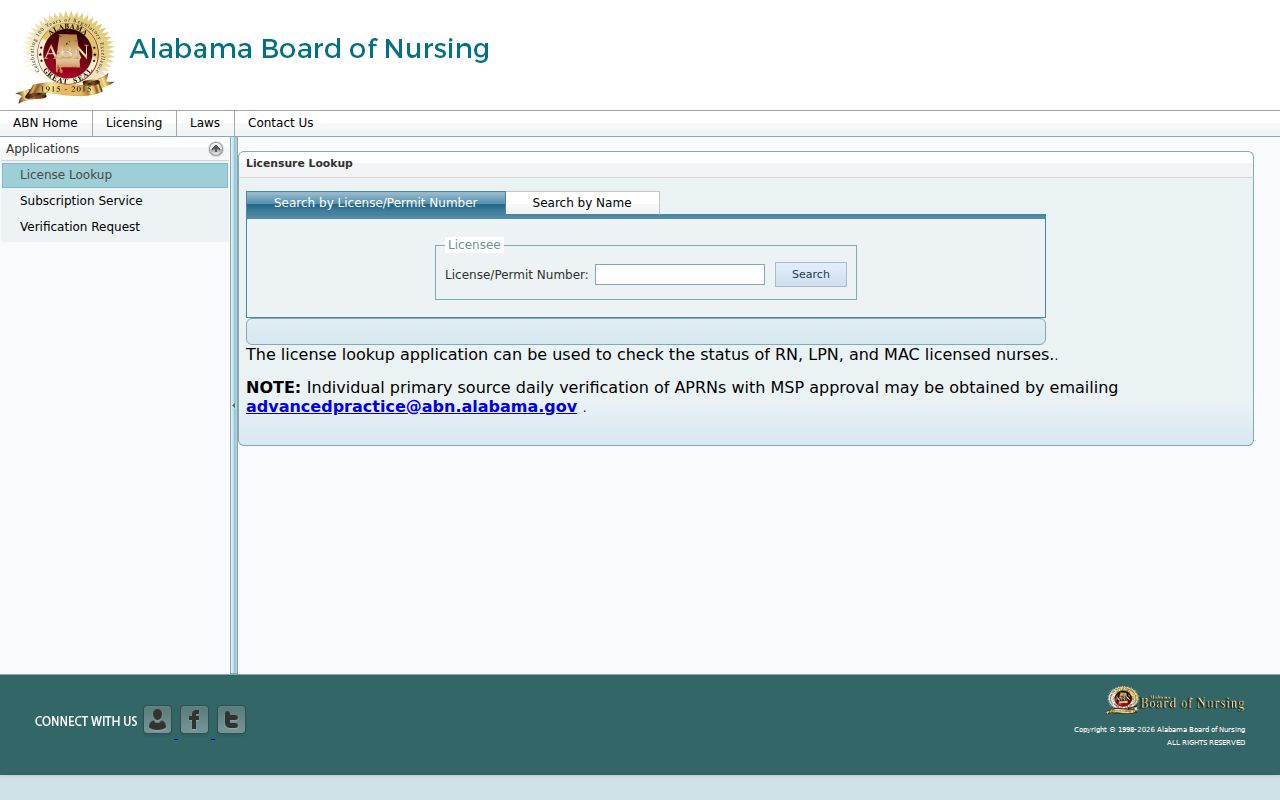
Nursing results tied to Opelika may also show license type, compact status, issue and expiration dates, and encumbrance history. Use those fields to verify a public credential, not to infer where the licensee lives.
Opelika Business Name Verification
The Alabama Secretary of State offers entity-name, entity-number, and officer, agent, or incorporator modes. Older six-digit IDs may appear as nine digits with three leading zeroes. An Opelika filing can connect an Opelika name to a registered role, address, status, and filing history. Yet an agent may be a service provider, and an Opelika filing address may not be a residence. Corporations from 1949 through 2010 may route to Alabama Archives when the current portal does not hold the record.
Opelika Revenue handles city business licenses, but no verified public license roster was found. A narrow request should seek only public fields such as business or trade name, physical location, public owner or contact, license type, status, and dates. Sensitive identifiers should be excluded. The City Clerk's NextRequest process is the written fallback for that municipal record. A city licensed site and an SOS principal address document different facts.
Professional-board and business-file results should remain separate in an identity check. A person may hold an Alabama credential without living in Opelika. A registered business may use an Opelika location without making its agent an occupant. Consistent Opelika names, dates, and roles can support identity, but they do not turn a professional or filing address into a household record.
When Opelika Records Go Offline
An online dead end in Opelika changes the channel. It should not change the custodian serving Opelika. For Opelika deeds and estates, use the Judge of Probate terminal, counter, or mail route. The electronic deed index begins July 1, 1986, and images begin June 1, 1997; earlier work uses handwritten cards and bound books. For Lee County court files, inspect at the Circuit Clerk or use the copy and archive form. For state certificates, use ADPH or a county health department.
City permits, license records, and other municipal material can be requested under the Opelika public-record procedure. The City Clerk accepts hand delivery, mail, email, or NextRequest. The September 2024 policy applies the Alabama-resident standing rule. Alabama's Open Records Act, Ala. Code §§36-12-40 to -41, has no universal response deadline, so a request should name the person or address, record class, and date range.
The records geography is also crucial. Municipal matters go to Opelika. Assessments, deeds, and circuit or district files go to Lee County offices. State certificates go to ADPH. Federal cases go to PACER and the Middle District clerk. Sending the same broad request to each office wastes time and can blur which record supports the identity check.
Limits on Opelika Resident Lookup
Public access has firm edges. Alabama court rules protect sealed matters and specified juvenile, adoption, victim, shelter, child-location, and at-risk-party information. Vital statutes close recent births and deaths. The voter self-check requires a name, birth date, and challenge response; it is not a neighborhood browser. An ordered voter extract follows its own statute and selection rules. It never reveals ballot choices. The ALEA Community Information Center publishes only information that qualifies under its governing laws:
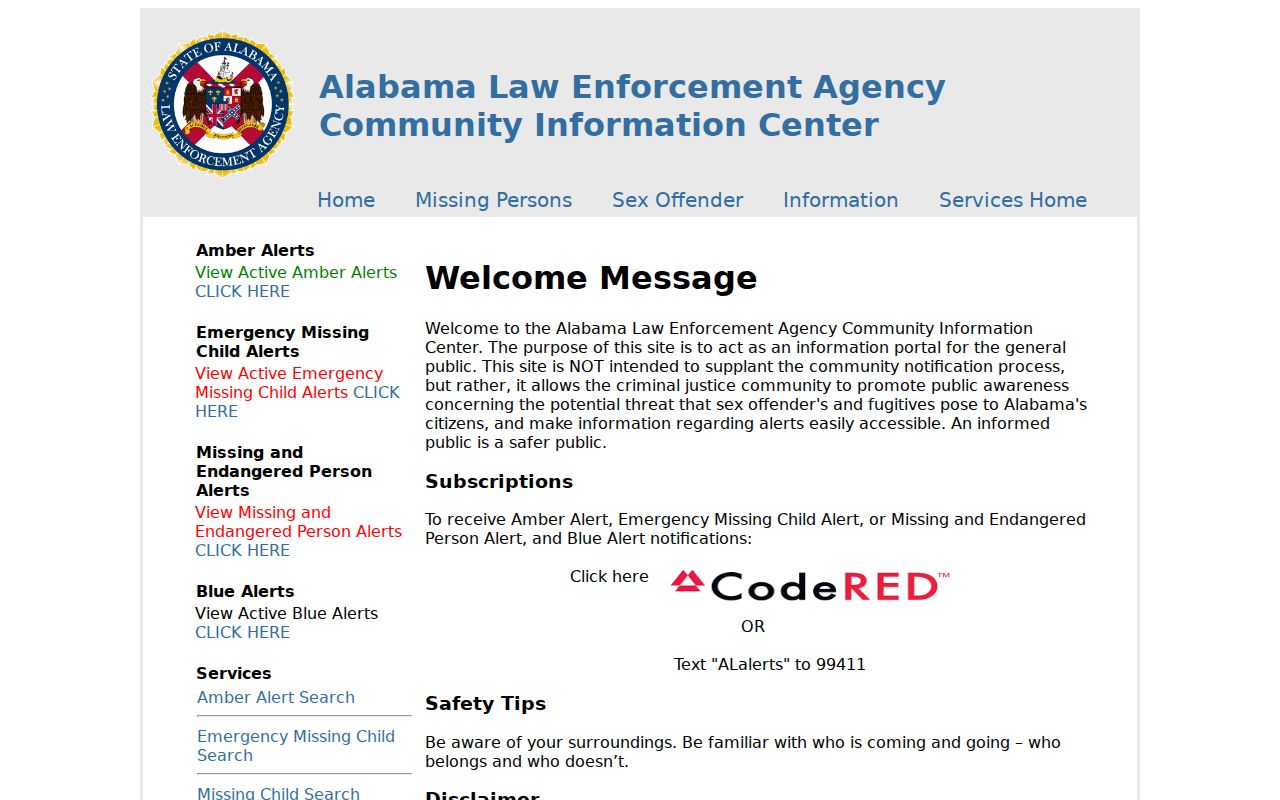
An omission from that portal is not proof that no other record exists. The portal's statutory publication limit must remain part of any careful Opelika reading.
Commercial people-finder tools may merge stale Opelika filings and unrelated names. Treat that category only as an Opelika lead, then verify through the office that holds the source. Alabama has no verified broad consumer deletion law or statewide substitute-address program. Protections are record-specific, and commercial opt-outs are handled service by service.
Lawful use. An Opelika resident lookup is for lawful personal research. Never use an address, filing, or family detail to stalk, threaten, harass, or harm anyone.